
San Diego Probation Defense: Leverage Your Compliance Record to Avoid Violations - Victor Orsatti
07
May
San Diego Probation Defense: Leverage Your Compliance Record to Avoid Violations
Table of Contents
- When Your Probation Officer Threatens Violation: The Real Stakes
- How Prior Compliance Becomes Your Greatest Defense Asset
- What the Prosecution Doesn't Want You to Know About Your Record
- Building a Strategic Compliance Defense Before the Hearing
- Documentation Strategies That Judges Actually Respect
- How We Use Your Compliance History to Negotiate Better Outcomes
- Probation Hearings: Presenting Your Record as Proof of Rehabilitation
- Common Probation Challenges and How Compliance Evidence Counters Them
- The Cost of Poor Probation Representation Versus Expert Defense
- Why Southern California Courts Recognize Our Compliance-Based Approach
- Next Steps: Protecting Your Probation Status Today
When Your Probation Officer Threatens Violation: The Real Stakes
Probation is supposed to be a second chance. But one misstep, one missed appointment, or one misunderstanding with your probation officer can put that second chance at serious risk. We’ve represented hundreds of probationers across Southern California who discovered that their probation officer’s threat of violation felt just as serious as their original conviction. The difference between keeping your freedom and facing incarceration often comes down to one thing: how well you’ve prepared your compliance defense.
A probation violation threat isn’t an informal warning. It’s the beginning of a process that can erase months or years of successful compliance and land you back in custody pending a hearing. Probation violations in San Diego County and throughout Southern California carry immediate consequences.
Here’s what happens: Your probation officer files a report alleging non-compliance. You may be arrested, held without bail, and scheduled for a violation hearing. Unlike a criminal trial, you don’t get the same level of procedural protection. The burden shifts differently. The prosecutor only needs to prove a violation by a preponderance of the evidence, not beyond reasonable doubt. That lower standard means judges are more likely to find violations and impose sanctions.
The stakes multiply depending on your original sentence. If your probation was a condition of a suspended prison sentence, a violation can activate that prison time immediately. If you were sentenced to “probation in lieu of custody,” a violation might result in jail time you thought you’d avoided. Even if incarceration isn’t imposed, a violation can extend your probation period, add new conditions, require counseling, increase restitution, or result in a permanent mark on your record.
We’ve seen probationers lose employment, housing, and custody arrangements because a violation derailed their entire compliance timeline. Your first action when a violation is alleged is to contact a criminal defense attorney who understands probation hearings specifically. Waiting for the hearing date without preparation is a gamble you can’t afford.
How Prior Compliance Becomes Your Greatest Defense Asset
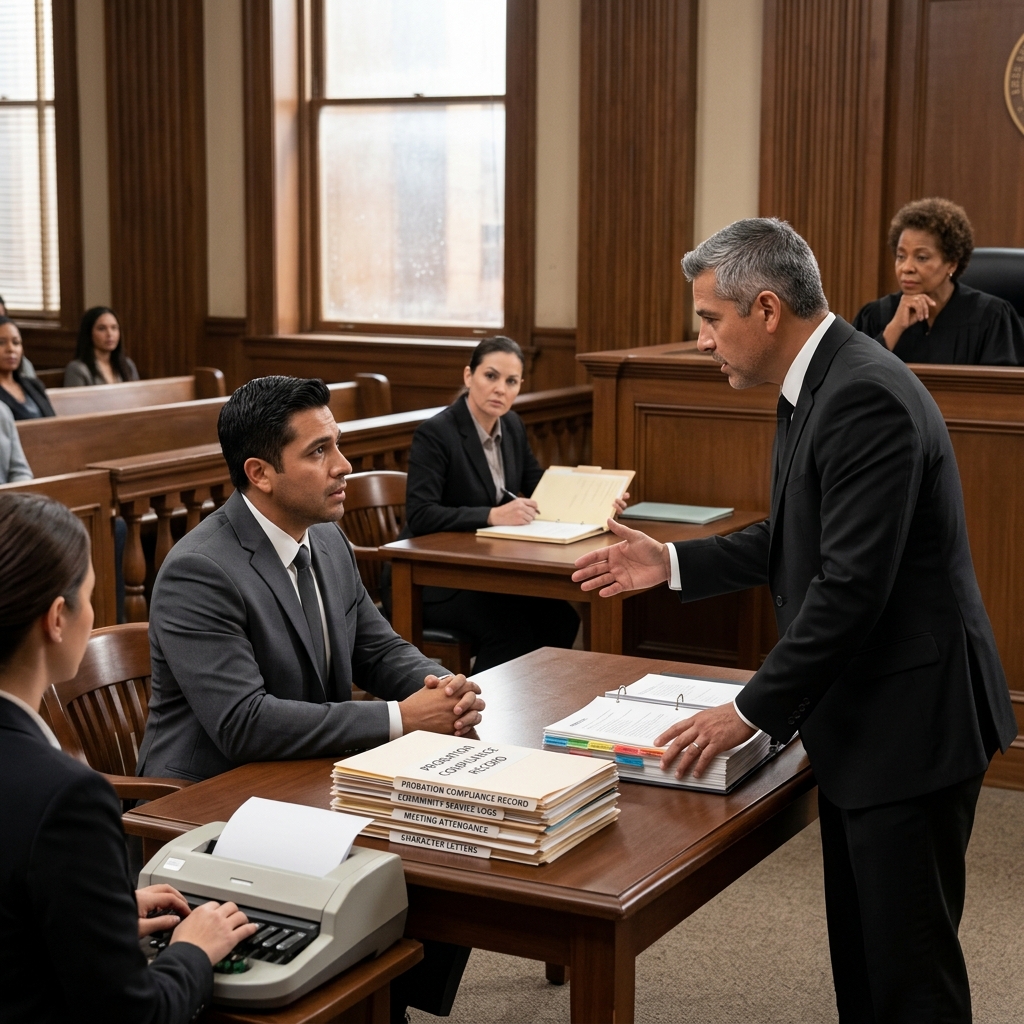
Judges evaluate probation violations within context. Your compliance history is the single most persuasive piece of evidence in your favor. If you’ve completed 18 months of probation without incident and one isolated mistake occurs, that history matters enormously.
We build violation defenses around documented compliance:
- Regular check-ins with your probation officer (without missed appointments)
- Completed treatment programs, counseling, or rehabilitation
- Steady employment or school enrollment with verification
- Restitution payments made on schedule
- Drug tests passed consistently (if drug testing was required)
- Community service hours completed
- Proof of housing stability
- Letters of support from employers, counselors, or family
This isn’t just character evidence. It’s proof that you understand the terms of your probation and have demonstrated the ability to follow them. When your probation officer cites one violation, your compliance record becomes the counterargument: “This is one incident in a pattern of overall compliance.”
Judges recognize that people under probation supervision are human. They expect occasional struggles. What they want to see is evidence that the probationer is genuinely trying and has been succeeding. Your compliance record demonstrates intent, effort, and rehabilitation. Start gathering this documentation immediately if you’re facing a violation allegation, and do so before your hearing.
What the Prosecution Doesn’t Want You to Know About Your Record
The prosecutor presenting the violation case relies on the probation officer’s version of events. They present the alleged violation as evidence of your non-compliance, but they often omit context that matters significantly. Specifically, they usually don’t present the full picture of your compliance history.
We’ve discovered through discovery and probation files that many probation officers focus narrowly on the violation without acknowledging months of successful compliance. They may not volunteer information about your consistent check-ins, completed programs, or on-time payments. The prosecution benefits from a narrow frame: “Here’s what you didn’t do on this date.”
Your defense expands that frame. We request your complete probation file, which includes your officer’s notes, contacts, and interactions over your entire probation period. This file often reveals patterns prosecutors hoped you wouldn’t see. You may find documented proof of compliance efforts your officer didn’t mention. You may discover that similar situations were previously handled informally, which suggests the violation allegation is disproportionate.
Additionally, we examine whether your probation conditions were realistic. Some probation terms are vague, contradictory, or impossible to follow. If your officer imposed an unachievable condition and then cited non-compliance, that defense becomes powerful. Prosecutors rarely advertise these vulnerabilities in their violation case.
Building a Strategic Compliance Defense Before the Hearing
Your violation hearing isn’t a trial, but it requires preparation as rigorous as trial prep. We start by analyzing the specific allegation. Is it factually accurate? Is it a technical violation or a serious breach? Can it be disputed? Is there an explanation your probation officer may have rejected but a judge might accept?
Next, we construct your compliance narrative:
- Gather all documentation of successful compliance
- Organize it chronologically to show pattern
- Identify witnesses who can testify to your compliance (employers, counselors, family)
- Prepare your statement explaining the violation incident
- Draft any letters or affidavits that strengthen your position
- Research similar cases and outcomes in your court
The strategy isn’t to deny every allegation. Sometimes, the strongest defense acknowledges what happened and reframes it within your broader compliance success. “Yes, I missed an appointment, but here’s why, and here are my 24 prior on-time check-ins this year. This was an anomaly, not a pattern.”
We also prepare for the prosecutor’s arguments and anticipate questions the judge will ask. Preparation transforms a violation hearing from a scary confrontation into a managed presentation of your case.
Documentation Strategies That Judges Actually Respect
Judges see hundreds of probation violation hearings. They can distinguish between casual claims and documented proof. Your compliance evidence should be organized, clear, and specific.
The documentation that resonates most:
- Pay stubs or employment verification letters (current job status)
- Certificates of completion from counseling, treatment, or classes
- Restitution payment receipts or bank records
- Calendar or log of check-in dates with annotations
- Negative drug test results with test dates
- Letters from your probation officer acknowledging compliance areas
- Community service documentation with hours and dates
- School transcripts or enrollment verification
- Housing lease or utility bills showing stable residence
Avoid vague statements. Instead of “I’ve been doing well,” present “I completed 40 hours of court-ordered community service between March and June 2026, as documented by this letter from the program supervisor.”
Organize documents in the order they’ll be discussed during your hearing. Create a simple index so the judge can follow. Bring copies for the prosecutor and judge. This level of preparation signals respect for the court and confidence in your position.
How We Use Your Compliance History to Negotiate Better Outcomes
Many probation violation cases resolve without a formal hearing through negotiation. Prosecutors and probation departments often have flexibility in how they respond to violations, especially when your compliance history is strong.
We engage in pre-hearing discussions with the prosecution and probation department. Our message is consistent: “Our client has demonstrated genuine compliance over an extended period. This single incident doesn’t reflect a pattern of non-compliance. A modest sanction that keeps our client on probation is appropriate, not revocation or extended incarceration.”

This approach works because:
- Prosecutors want to conserve court resources
- Judges prefer probation to incarceration when possible
- Probation departments recognize successful probationers
- Your compliance record creates pressure to resolve reasonably
We’ve negotiated outcomes where violations that could have resulted in 90 days in custody instead resulted in extended probation, increased restitution, or additional counseling. We’ve seen probation officers agree to reinstatement without penalty when your compliance history demonstrates the violation was truly an exception.
Negotiation requires knowing your case’s weakness and your case’s strength. We identify both before we negotiate, which means we never accept a worse outcome than what a judge would likely impose.
Probation Hearings: Presenting Your Record as Proof of Rehabilitation
If negotiations fail, your violation hearing becomes the critical moment. Unlike trial, you can testify without the risk of cross-examination destroying your case. We prepare your testimony to be compelling, honest, and supported by the documentation you’ve gathered.
Your hearing testimony should follow this arc:
- Acknowledge the violation specifically (avoid sounding evasive)
- Explain the circumstances without making excuses
- Connect this incident to your broader compliance pattern
- Present your compliance documentation
- Discuss what this probation period has taught you
- Explain your commitment to remaining in compliance
Judges listen closely to how you discuss your probation. If you minimize the violation, you lose credibility. If you over-apologize, you sound coached. If you blame your probation officer, you lose. The right approach is accountable and confident: “Here’s what happened, here’s why it’s not reflective of my overall compliance, and here’s proof.”
We may also present witness testimony from your employer, counselor, or family members who can speak to your compliance efforts and character. Their perspective carries weight because they’re not directly involved in the case.
Common Probation Challenges and How Compliance Evidence Counters Them
Probation violations typically fall into predictable categories. Your compliance history speaks directly to most of them.
Missed appointments or check-ins: If you’ve had perfect attendance for months, one missed appointment becomes explainable. Maybe you miscommunicated about timing, maybe you had a legitimate emergency. Your pattern shows it’s not habitual.
Failed drug tests: Compliance evidence of passing multiple other tests, participation in treatment, and lifestyle stability makes a single positive test less likely to result in revocation. It frames the positive as an anomaly.
Employment changes: If your probation required you to maintain employment and you were fired, your compliance history regarding your job search, new employment, or training efforts will matter. You showed you tried.
Restitution delays: Documented payments over time, even if not always on schedule, prove you’re committed to fulfilling this obligation. Compliance history shows progress.

Failure to complete required programs: If you’ve completed some programs successfully, partial progress combined with compliance in other areas makes judges more willing to extend your timeline rather than revoke you.
Technical violations: Violations like missing a court date, moving without permission, or violating a curfew become far less serious when surrounded by documented good behavior everywhere else.
The Cost of Poor Probation Representation Versus Expert Defense
Many probationers try to handle violation hearings alone or rely on inexperienced attorneys who treat violations as minor matters. The cost of that mistake is incarceration.
Without expert probation defense, probationers often:
- Don’t gather their compliance documentation strategically
- Fail to request their complete probation file
- Testify without preparation and hurt their own case
- Don’t negotiate before the hearing
- Accept outcomes that could have been avoided
The difference between a probation violation that results in probation extension and one that results in 90 days in custody is often a matter of how well your case was presented. We’ve seen judges impose incarceration on probationers with strong compliance histories because their attorney didn’t organize that history effectively for the judge to see.
The investment in skilled probation representation pays for itself immediately if it means avoiding custody. It also pays in the long term: successful probation completion protects your career, your housing, your custody arrangements, and your future record.
Why Southern California Courts Recognize Our Compliance-Based Approach
We’ve developed our probation violation defense strategy across five Southern California counties: San Diego, Orange, Riverside, and San Bernardino. Each court has distinct preferences and practices. We know which judges value compliance evidence most heavily, which prosecutors negotiate seriously, and which probation departments prioritize rehabilitation over punishment.
Our approach is rooted in how Southern California judges actually think about probation violations. They understand that probation is meant to supervise rehabilitation, not trap people in technical failure. When we present a compliance-centered defense, we’re speaking the language these courts prefer.
We maintain relationships with probation departments because we handle these cases regularly and ethically. That familiarity means probation officers are more likely to engage in honest pre-hearing discussions with us. We also know how to read probation files strategically, identifying the evidence courts find most persuasive.
Next Steps: Protecting Your Probation Status Today
If you’re facing a probation violation allegation in Southern California, your first step is immediate action. Violations move quickly, and preparation time is limited.
Contact us today for a free 24/7 consultation. We’ll review your violation allegation, assess your compliance history, and develop a defense strategy. We offer flexible payment plans and affordable flat-fee representation, so cost won’t prevent you from mounting an effective defense.
The stakes are too high to wait. Your probation status, your freedom, and your future employment and housing are at risk. Probation violations are exactly what we defend against every day, and we know how to use your compliance record to protect your probation and your life.
San Diego Probation Defense: Leverage Your Compliance Record to Avoid Violations
Table of Contents
- When Your Probation Officer Threatens Violation: The Real Stakes
- How Prior Compliance Becomes Your Greatest Defense Asset
- What the Prosecution Doesn't Want You to Know About Your Record
- Building a Strategic Compliance Defense Before the Hearing
- Documentation Strategies That Judges Actually Respect
- How We Use Your Compliance History to Negotiate Better Outcomes
- Probation Hearings: Presenting Your Record as Proof of Rehabilitation
- Common Probation Challenges and How Compliance Evidence Counters Them
- The Cost of Poor Probation Representation Versus Expert Defense
- Why Southern California Courts Recognize Our Compliance-Based Approach
- Next Steps: Protecting Your Probation Status Today
When Your Probation Officer Threatens Violation: The Real Stakes
Probation is supposed to be a second chance. But one misstep, one missed appointment, or one misunderstanding with your probation officer can put that second chance at serious risk. We’ve represented hundreds of probationers across Southern California who discovered that their probation officer’s threat of violation felt just as serious as their original conviction. The difference between keeping your freedom and facing incarceration often comes down to one thing: how well you’ve prepared your compliance defense.
A probation violation threat isn’t an informal warning. It’s the beginning of a process that can erase months or years of successful compliance and land you back in custody pending a hearing. Probation violations in San Diego County and throughout Southern California carry immediate consequences.
Here’s what happens: Your probation officer files a report alleging non-compliance. You may be arrested, held without bail, and scheduled for a violation hearing. Unlike a criminal trial, you don’t get the same level of procedural protection. The burden shifts differently. The prosecutor only needs to prove a violation by a preponderance of the evidence, not beyond reasonable doubt. That lower standard means judges are more likely to find violations and impose sanctions.
The stakes multiply depending on your original sentence. If your probation was a condition of a suspended prison sentence, a violation can activate that prison time immediately. If you were sentenced to “probation in lieu of custody,” a violation might result in jail time you thought you’d avoided. Even if incarceration isn’t imposed, a violation can extend your probation period, add new conditions, require counseling, increase restitution, or result in a permanent mark on your record.
We’ve seen probationers lose employment, housing, and custody arrangements because a violation derailed their entire compliance timeline. Your first action when a violation is alleged is to contact a criminal defense attorney who understands probation hearings specifically. Waiting for the hearing date without preparation is a gamble you can’t afford.
How Prior Compliance Becomes Your Greatest Defense Asset
Judges evaluate probation violations within context. Your compliance history is the single most persuasive piece of evidence in your favor. If you’ve completed 18 months of probation without incident and one isolated mistake occurs, that history matters enormously.
We build violation defenses around documented compliance:
- Regular check-ins with your probation officer (without missed appointments)
- Completed treatment programs, counseling, or rehabilitation
- Steady employment or school enrollment with verification
- Restitution payments made on schedule
- Drug tests passed consistently (if drug testing was required)
- Community service hours completed
- Proof of housing stability
- Letters of support from employers, counselors, or family
This isn’t just character evidence. It’s proof that you understand the terms of your probation and have demonstrated the ability to follow them. When your probation officer cites one violation, your compliance record becomes the counterargument: “This is one incident in a pattern of overall compliance.”
Judges recognize that people under probation supervision are human. They expect occasional struggles. What they want to see is evidence that the probationer is genuinely trying and has been succeeding. Your compliance record demonstrates intent, effort, and rehabilitation. Start gathering this documentation immediately if you’re facing a violation allegation, and do so before your hearing.
What the Prosecution Doesn’t Want You to Know About Your Record
The prosecutor presenting the violation case relies on the probation officer’s version of events. They present the alleged violation as evidence of your non-compliance, but they often omit context that matters significantly. Specifically, they usually don’t present the full picture of your compliance history.
We’ve discovered through discovery and probation files that many probation officers focus narrowly on the violation without acknowledging months of successful compliance. They may not volunteer information about your consistent check-ins, completed programs, or on-time payments. The prosecution benefits from a narrow frame: “Here’s what you didn’t do on this date.”
Your defense expands that frame. We request your complete probation file, which includes your officer’s notes, contacts, and interactions over your entire probation period. This file often reveals patterns prosecutors hoped you wouldn’t see. You may find documented proof of compliance efforts your officer didn’t mention. You may discover that similar situations were previously handled informally, which suggests the violation allegation is disproportionate.
Additionally, we examine whether your probation conditions were realistic. Some probation terms are vague, contradictory, or impossible to follow. If your officer imposed an unachievable condition and then cited non-compliance, that defense becomes powerful. Prosecutors rarely advertise these vulnerabilities in their violation case.
Building a Strategic Compliance Defense Before the Hearing
Your violation hearing isn’t a trial, but it requires preparation as rigorous as trial prep. We start by analyzing the specific allegation. Is it factually accurate? Is it a technical violation or a serious breach? Can it be disputed? Is there an explanation your probation officer may have rejected but a judge might accept?
Next, we construct your compliance narrative:
- Gather all documentation of successful compliance
- Organize it chronologically to show pattern
- Identify witnesses who can testify to your compliance (employers, counselors, family)
- Prepare your statement explaining the violation incident
- Draft any letters or affidavits that strengthen your position
- Research similar cases and outcomes in your court
The strategy isn’t to deny every allegation. Sometimes, the strongest defense acknowledges what happened and reframes it within your broader compliance success. “Yes, I missed an appointment, but here’s why, and here are my 24 prior on-time check-ins this year. This was an anomaly, not a pattern.”
We also prepare for the prosecutor’s arguments and anticipate questions the judge will ask. Preparation transforms a violation hearing from a scary confrontation into a managed presentation of your case.
Documentation Strategies That Judges Actually Respect
Judges see hundreds of probation violation hearings. They can distinguish between casual claims and documented proof. Your compliance evidence should be organized, clear, and specific.
The documentation that resonates most:
- Pay stubs or employment verification letters (current job status)
- Certificates of completion from counseling, treatment, or classes
- Restitution payment receipts or bank records
- Calendar or log of check-in dates with annotations
- Negative drug test results with test dates
- Letters from your probation officer acknowledging compliance areas
- Community service documentation with hours and dates
- School transcripts or enrollment verification
- Housing lease or utility bills showing stable residence
Avoid vague statements. Instead of “I’ve been doing well,” present “I completed 40 hours of court-ordered community service between March and June 2026, as documented by this letter from the program supervisor.”
Organize documents in the order they’ll be discussed during your hearing. Create a simple index so the judge can follow. Bring copies for the prosecutor and judge. This level of preparation signals respect for the court and confidence in your position.
How We Use Your Compliance History to Negotiate Better Outcomes
Many probation violation cases resolve without a formal hearing through negotiation. Prosecutors and probation departments often have flexibility in how they respond to violations, especially when your compliance history is strong.
We engage in pre-hearing discussions with the prosecution and probation department. Our message is consistent: “Our client has demonstrated genuine compliance over an extended period. This single incident doesn’t reflect a pattern of non-compliance. A modest sanction that keeps our client on probation is appropriate, not revocation or extended incarceration.”
This approach works because:
- Prosecutors want to conserve court resources
- Judges prefer probation to incarceration when possible
- Probation departments recognize successful probationers
- Your compliance record creates pressure to resolve reasonably
We’ve negotiated outcomes where violations that could have resulted in 90 days in custody instead resulted in extended probation, increased restitution, or additional counseling. We’ve seen probation officers agree to reinstatement without penalty when your compliance history demonstrates the violation was truly an exception.
Negotiation requires knowing your case’s weakness and your case’s strength. We identify both before we negotiate, which means we never accept a worse outcome than what a judge would likely impose.
Probation Hearings: Presenting Your Record as Proof of Rehabilitation
If negotiations fail, your violation hearing becomes the critical moment. Unlike trial, you can testify without the risk of cross-examination destroying your case. We prepare your testimony to be compelling, honest, and supported by the documentation you’ve gathered.
Your hearing testimony should follow this arc:
- Acknowledge the violation specifically (avoid sounding evasive)
- Explain the circumstances without making excuses
- Connect this incident to your broader compliance pattern
- Present your compliance documentation
- Discuss what this probation period has taught you
- Explain your commitment to remaining in compliance
Judges listen closely to how you discuss your probation. If you minimize the violation, you lose credibility. If you over-apologize, you sound coached. If you blame your probation officer, you lose. The right approach is accountable and confident: “Here’s what happened, here’s why it’s not reflective of my overall compliance, and here’s proof.”
We may also present witness testimony from your employer, counselor, or family members who can speak to your compliance efforts and character. Their perspective carries weight because they’re not directly involved in the case.
Common Probation Challenges and How Compliance Evidence Counters Them
Probation violations typically fall into predictable categories. Your compliance history speaks directly to most of them.
Missed appointments or check-ins: If you’ve had perfect attendance for months, one missed appointment becomes explainable. Maybe you miscommunicated about timing, maybe you had a legitimate emergency. Your pattern shows it’s not habitual.
Failed drug tests: Compliance evidence of passing multiple other tests, participation in treatment, and lifestyle stability makes a single positive test less likely to result in revocation. It frames the positive as an anomaly.
Employment changes: If your probation required you to maintain employment and you were fired, your compliance history regarding your job search, new employment, or training efforts will matter. You showed you tried.
Restitution delays: Documented payments over time, even if not always on schedule, prove you’re committed to fulfilling this obligation. Compliance history shows progress.
Failure to complete required programs: If you’ve completed some programs successfully, partial progress combined with compliance in other areas makes judges more willing to extend your timeline rather than revoke you.
Technical violations: Violations like missing a court date, moving without permission, or violating a curfew become far less serious when surrounded by documented good behavior everywhere else.
The Cost of Poor Probation Representation Versus Expert Defense
Many probationers try to handle violation hearings alone or rely on inexperienced attorneys who treat violations as minor matters. The cost of that mistake is incarceration.
Without expert probation defense, probationers often:
- Don’t gather their compliance documentation strategically
- Fail to request their complete probation file
- Testify without preparation and hurt their own case
- Don’t negotiate before the hearing
- Accept outcomes that could have been avoided
The difference between a probation violation that results in probation extension and one that results in 90 days in custody is often a matter of how well your case was presented. We’ve seen judges impose incarceration on probationers with strong compliance histories because their attorney didn’t organize that history effectively for the judge to see.
The investment in skilled probation representation pays for itself immediately if it means avoiding custody. It also pays in the long term: successful probation completion protects your career, your housing, your custody arrangements, and your future record.
Why Southern California Courts Recognize Our Compliance-Based Approach
We’ve developed our probation violation defense strategy across five Southern California counties: San Diego, Orange, Riverside, and San Bernardino. Each court has distinct preferences and practices. We know which judges value compliance evidence most heavily, which prosecutors negotiate seriously, and which probation departments prioritize rehabilitation over punishment.
Our approach is rooted in how Southern California judges actually think about probation violations. They understand that probation is meant to supervise rehabilitation, not trap people in technical failure. When we present a compliance-centered defense, we’re speaking the language these courts prefer.
We maintain relationships with probation departments because we handle these cases regularly and ethically. That familiarity means probation officers are more likely to engage in honest pre-hearing discussions with us. We also know how to read probation files strategically, identifying the evidence courts find most persuasive.
Next Steps: Protecting Your Probation Status Today
If you’re facing a probation violation allegation in Southern California, your first step is immediate action. Violations move quickly, and preparation time is limited.
Contact us today for a free 24/7 consultation. We’ll review your violation allegation, assess your compliance history, and develop a defense strategy. We offer flexible payment plans and affordable flat-fee representation, so cost won’t prevent you from mounting an effective defense.
The stakes are too high to wait. Your probation status, your freedom, and your future employment and housing are at risk. Probation violations are exactly what we defend against every day, and we know how to use your compliance record to protect your probation and your life.